

When one of India’s most successful businesswomen breaks her silence about infertility, the world should listen.
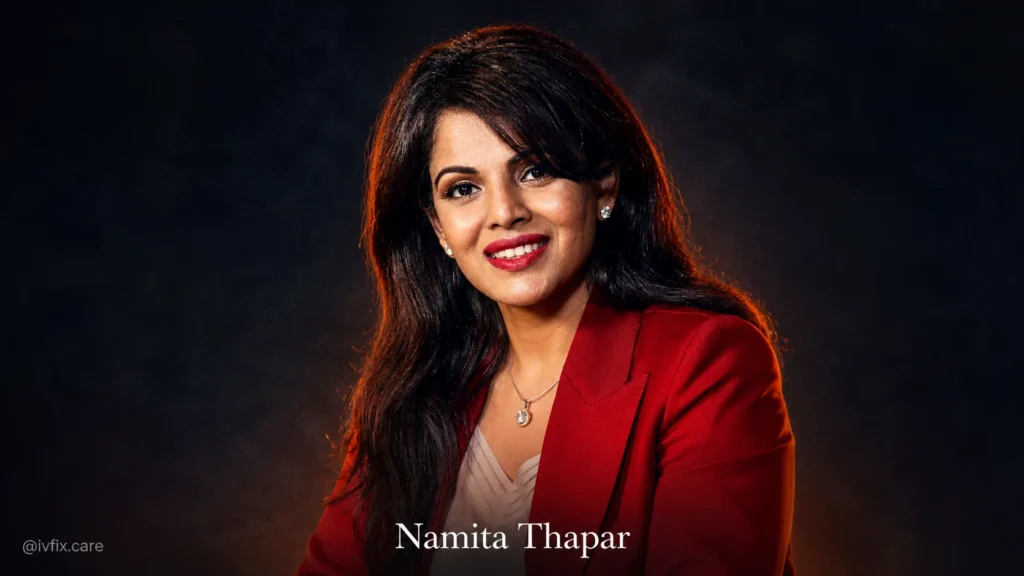
Namita Thapar, Executive Director of Emcure Pharmaceuticals and one of the most recognised faces from Shark Tank India, recently did something very few public figures in India have the courage to do. She spoke openly about her two failed IVF attempts, the physical pain of 25 injections, and the emotional trauma that stayed with her for over 10 years.
This is her story. And it might be yours too.
Who Is Namita Thapar?
Before we get into the IVF journey, it is important to understand who Namita Thapar is — because her story is powerful precisely because of who she is.
Namita Thapar is the Executive Director of Emcure Pharmaceuticals, one of India’s largest pharmaceutical companies. She is a Chartered Accountant, a Harvard Business School alumna, and has been named among India’s most influential businesswomen multiple times.
She is also a mother, a wife, an author, and a woman who silently went through one of the most painful fertility journeys imaginable, while the world only saw her success.
The Story — In Her Own Words
Namita revealed that at the age of 28, she wanted to get pregnant and conceived naturally within two months, having a completely normal pregnancy.
But life had other plans.
After 3 to 4 years, she had to deal with infertility issues while trying for her second child. She then chose to take the IVF route two times, which resulted in taking 25 injections, causing her emotional and physical pain. Business Today
Think about that for a moment. Twenty-five injections. Each one is a needle. Each one a hope. Each one followed by waiting, praying, and then disappointment.
“I have gone through 2 infertility treatments and those 25 injections and the emotional and physical pain that I went through,” she shared on national television — in front of millions of viewers.
After two attempts, she gave up and said she was happy with one child. But then a miracle happened, and she conceived naturally. However, the memory stayed with her.
10 Years of Silence
What makes Namita’s story truly heartbreaking — and truly important — is not just the failed IVF attempts. It is the decade of silence that followed.
For 10 years, she could not talk about it publicly. Even on her YouTube channel, she could not speak about it as it felt like a taboo — a scar. She stayed up all night thinking about whether she could go public about this experience.
This is the reality of infertility in India. Even the most successful, educated, financially independent women carry this pain in silence — because society makes them feel ashamed for something that is completely beyond their control.
She openly spoke about how the process impacts a woman’s physical and mental health, describing the physical and emotional trauma, and the taboos like being told to cross your legs, doing all sorts of things that made no sense medically.
She finally wrote about it in her book. And then, on a national Shark Tank India episode, she said it out loud — for every woman sitting at home who has felt the same way but had no one to say it for them.
Why This Story Matters for Every Indian Woman
Namita Thapar is not just a celebrity. She is a mirror.
She had money. She had access to the best doctors. She had education and resources that most Indian women can only dream of. And still — IVF failed. Twice. And still, she could not talk about it for 10 years.
Now imagine the millions of Indian women who have none of those advantages. Women in smaller cities. Women who cannot afford multiple IVF cycles. Women whose families blame them. Women who do not even know that infertility is a medical condition, not a personal failure.
Here are the real numbers:
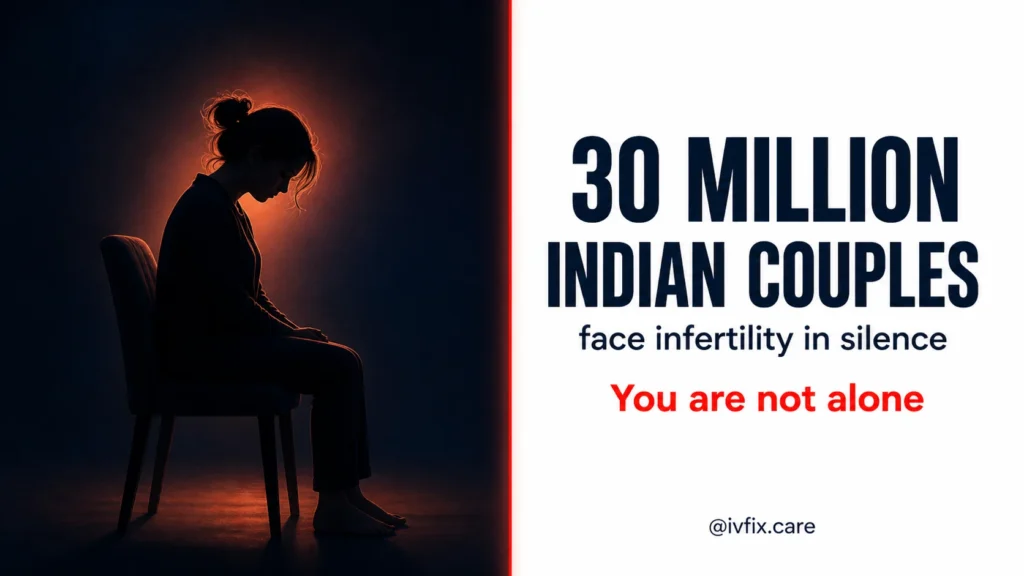
- Approximately 15 to 20 percent of Indian couples — nearly 30 million — currently struggle with infertility.
- Male factors are now responsible for 40 to 50 percent of cases, linked to deterioration in sperm quality from environmental toxins and stress.
- IVF treatments in India are expensive, with each cycle typically costing between Rs 1 to 3 lakh, and nearly 90 percent of couples undergoing IVF currently face catastrophic expenses due to multiple treatment cycles and limited insurance support.
Namita had resources that most people do not. And she still struggled. This is not a rich person’s problem or a poor person’s problem. Infertility does not discriminate.
What Happens During IVF — Understanding the Pain
Many people hear “IVF failed” and don’t fully understand what that means physically and emotionally. Let us explain it simply.
What IVF involves:
Step 1 — Ovarian Stimulation The woman receives daily hormone injections — sometimes for 10 to 14 days — to stimulate the ovaries to produce multiple eggs. This is where Namita’s 25 injections came from. The injections cause bloating, mood swings, fatigue, and sometimes severe discomfort.
Step 2 — Egg Retrieval Under mild anaesthesia, a doctor retrieves the eggs from the ovaries using a thin needle. It is a minor surgical procedure, but it is physically demanding.
Step 3 — Fertilisation in the Lab The retrieved eggs are combined with sperm in a laboratory. If fertilisation is successful, embryos develop over 3 to 5 days.
Step 4 — Embryo Transfer: One or more embryos are placed back into the uterus. Then comes the hardest part — the two-week wait — to find out if implantation worked.
Step 5 — The Result: A blood test measures the pregnancy hormone HCG. When the result is negative — after all those injections, all those hospital visits, all that hope — the emotional crash is devastating.
Now multiply that by two. That is what Namita went through.
The Emotional Side Nobody Talks About
IVF failure is not just a medical event. It is a grief.
Women describe it as mourning a child that almost was. The hormonal changes from the injections alone cause intense emotional swings. Add the pressure of family expectations, the financial stress, the physical exhaustion — and it becomes one of the most overwhelming experiences a human being can go through.
Namita expressed how the 2 failed IVF procedures took a serious toll on her physical and emotional health. She later made peace with it, since she already had a child, but would always wonder about parents who find their last hope in such treatments. Hauterrfly
This is the part most people miss. Even after the pain passed for Namita, she thought about all the others who do not have a child yet. Who have no “backup”. Who are on their third, fourth, or fifth attempt. Who are running out of money and hope at the same time.
If that is you, please know this: IVF failure does not mean the end. And it is never your fault.
What You Should Do If You Are Struggling
Namita’s story teaches us one very important thing: do not wait, and do not stay silent.
She tried naturally for 3 to 4 years before seeking help. Many women in India wait even longer — because of stigma, because of hope, because nobody told them early testing matters.
Here is what fertility experts recommend:
✅ If you are under 35 — see a fertility doctor after 12 months of trying naturally without success
✅ If you are over 35 — see a doctor after just 6 months
✅ Get tested early — AMH test, FSH, LH, HSG test, and semen analysis for your partner. Early testing saves time, money, and heartbreak
✅ Do not ignore the male factor — in nearly half of all infertility cases, the issue is with the male partner. Both partners should be tested at the same time
✅ Talk to someone — the silence Namita carried for 10 years cost her 10 years of unnecessary shame. Find a support group, a counsellor, or simply someone who understands
✅ Explore all options — IVF is not the only path. IUI, ICSI, lifestyle changes, and medication can all play a role, depending on your diagnosis
A Message to Every Woman Reading This
If Namita Thapar — a Harvard-educated pharmaceutical executive with access to the best medical care in India — could go through 2 failed IVF cycles and feel ashamed to talk about it for 10 years, then the problem is not with you.
The problem is with the silence our society forces on women.
You are not broken. You are not cursed. You are not less of a woman because conception is difficult.
Infertility is a medical condition. It deserves medical attention, emotional support, and zero shame.
Namita finally found her voice. You deserve yours, too.
Have Questions About IVF or Fertility?
At IVFix, we are here to answer every question — simply, clearly, and without judgment.
📲 WhatsApp us free: +91 85950 44122 📸 Follow for daily tips: @ivfix.care 🌐 Read more: ivfix.in
We are not a clinic. We do not sell treatments. We just believe every woman deserves clear answers.